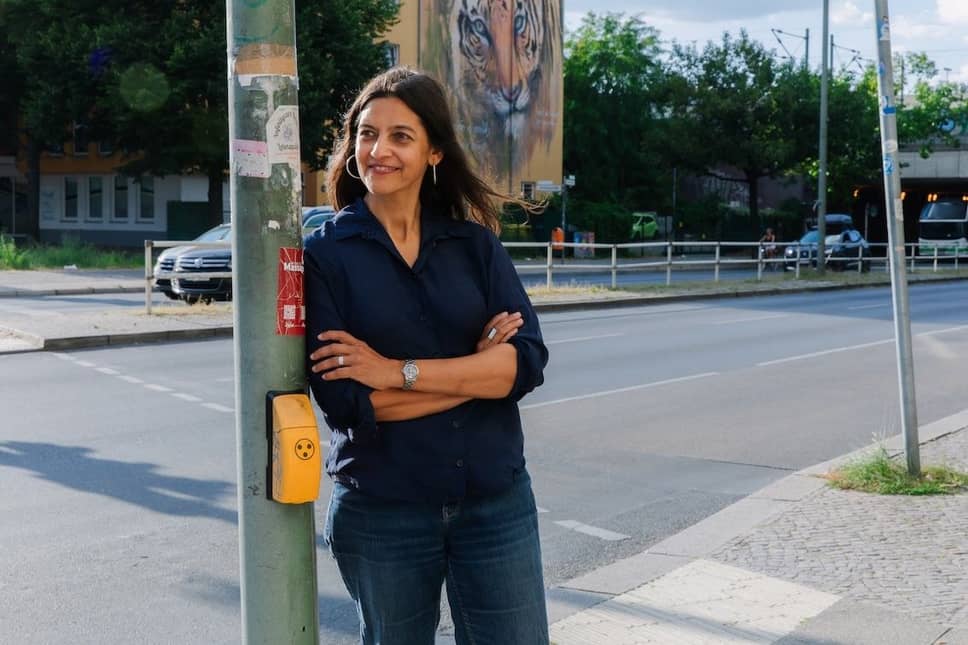
Could we start by talking about you and your practice and work in Bristol?
I have parallel practices as an artist and lecturer in Fine Art, and I work between these spaces to investigate the edges of what is possible within the realms of sculptural installation, photography, collage, drawing, sound and moving image.
My work draws on my lived experiences alongside themes of the city as site and subject, collective memory, globalisation, migration and fragmented histories. I think of artworks as timekeepers that stand as inconvenient witnesses; marking emotional histories, witnessing and testifying the sorrowful, the futile, and the funny. For example, an old idea gained resolution during the actions taken by protestors who pulled down the statue of Edward Colston in Bristol, resulting in the work Raat Ki Raani (shown at MIRROR, Plymouth in 2022).
-

Raat Ki Raani (Exhibition View, Your Tongue in My Mouth, MIRROR, Plymouth) Giclee´ Print on Innova Photorag and Mixed Media on Plywood, 2022. Photo: Dom Moore -

Raat Ki Raani (Exhibition View, Your Tongue in My Mouth, MIRROR, Plymouth) Giclee´ Print on Innova Photorag and Mixed Media on Plywood, 2022. Photo: Dom Moore
Sometimes tentative ideas from decades ago solidify in the present. Some continue to remain fragile, but refuse to disappear, and become ghosts, haunting other works I produce. Doubt and uncertainty have coalesced in my practice and I see this scepticism as an intention, a deliberated position.
In a recent work, I began with an investigation of voice, language, and breath; as a whimsical performance, I brought back water from the Arabian sea in Karachi to pour into the river Avon in Bristol to contaminate it. The perpetual presence of Bristol tides, churning mud, and the Severn Estuary serving as backdrop. Social, political, personal experiences fugitively folding into practice.
Alongside this, the journey of the elusive European Eel, from ocean to rivers and marshes, and back home to the Sargasso sea, led me to understand movement as a state that is productive and transformative. It demands adaptability and inventiveness. This perpetual migration is also the state of many nations, the backdrop of a colonial reality as the architect of displacement and exile.
Looking at the most recent work, I would say that movement and migration in its broadest sense - as a way to be in the world, as a way of becoming and/or transforming - is something I continue to insist on. I try to find ways to understand and express this through staging visual and material encounters to investigate how power plays out, manifests itself, or is resisted.
In a recent project, Bombay Duck, the encounter of two materials, glass and mangrove wood, became a metaphor to explore what happens when blown glass in its molten state (in the process of becoming) encounters a surface that supports and shapes it, but also scorches it with its heat. Both materials are altered by the confrontation, yielding to each other, bearing the trace and memory of the encounter.

Similarly, I am drawn to the meeting of rivers and oceans, forming estuaries which, like the port cities that I love, are resilient and dynamic sites of exchange, interruption and arbitration. They give refuge to so much diverse life which thrives in this brackish water, where saline oceans, tidal rivers, and restless wind are in continuous negotiation. Like estuaries, which are tremendously fragile ecosystems, and the exiled body, glass too can withstand the intense heat of a kiln, but can shatter at the slightest touch.
Where do you make your work, do you have a studio space in the city?
Despite spending a lot of time in my studio in recent years, I am not really a studio artist. My best work is made on the move, in multiple places, in encounters with others who lend their skills to my ideas, or ideas to my questions. Most of my life I have produced work in big cities like Karachi and Lahore, at different locations: at the ship building yard, in markets, at roadside welding shops, at tiny foundries and electroplating dens; powder coating something here, casting something there, staging photographs in the street, working with taxidermists, toy factories, book binders, embroiderers who otherwise make wedding clothes, etc. It is a joy to work like this. You are challenged, and in conversation and confrontation with the moment. You learn to take your ideas lightly and flexibly, but also learn to fine tune your position in the context of others’ equally valid position. You metamorphose along the way. The city has been a collaborator for me for as long as I remember, even before I was trained as “an artist”, I learned to make a pair of shoes with a cobbler under a banyan tree in my neighbourhood. Over the years in Bristol, I have become a little bit more of a studio artist, largely for practical reasons, but have also found equivalence in working with incredibly knowledgeable glass blowers at Teignvalley glass studios, Upcycled Glass, and the Berlin Glass studios, or with Jacky Puzey to embroider new work in Bristol. In places where I have taught, Plymouth and Bristol, technicians have been my co-thinkers, and I have had a lot of help from them in problem solving and realising mad ideas which I could not give form to on my own.

What resources or facilities are there that you (can) access?
Spike Island’s studios are full of people who are my richest resource. I can knock on doors to ask for technical help, run ideas past artists, ask for a hand to lift something heavy, borrow or recycle equipment and tools, or use the wood and metal workshop. Spike Print is a treasure within a treasure, full of opportunities to experiment with traditional and new ways of using print - which I don’t use enough. City Edition Studio, a graphic design practice run by Jono Lewarne where I have produced Riso Print editions, is also based within the building and is amazing; and several BEEF Bristol (Bristol Expanded and Experimental Film) collective artists have studios here who I learn much from.
Nearby Hello Blue, a printing company, prints high-quality images; I also have the privilege of teaching at a University which has fabrication studios within walking distance of Spike Island. When students are on vacation, I have been able to learn to throw pots, scan and 3D print objects, make casts or use the industrial sewing machines.

What are the great art spaces and organisations you love to visit?
Spike Island is where my two worlds as an artist and Fine Art lecturer converge (The University of West of England runs its Fine Art programmes from the building and I also have a studio there). I am here a lot and love the fact that I can view the same exhibition repeatedly over a period of months in the Spike galleries, or at Arnolfini, which is on my route to work.
Bristol is an unusual city, with very few commercial art spaces. Exhibition or residency spaces and studios like KIT FORM, the Laundrette, St. Anne’s House, Watershed, and other transient exhibition spaces initiated by the city’s many exceptional artists are often experimental, event based and critical. This approach feels like a refusal to be part of a more established system of producing, monetising and distributing art.
Beyond Bristol, I go to see exhibitions of my beloveds: my partner, friends, peers and students in Exeter, Plymouth, Cardiff, Swansea and London. Although this is not the South West, I am currently enjoying the programming at Ibraaz, a new-ish space in London.

What opportunities are there for artists in your area?
The upside of Bristol developing at such a chilling rate is that there are a number of opportunities for public commissions. Spike Open is an annual event and the South West Artist Commission a biennial event, which often have open calls for artists who may not be directly associated with Spike. Spike Associates is a generous opportunity for artists to work within the building and access regular events and activities. And of course St. Anne’s House has excellent programming.
What or who helps you maintain your practice?
My teaching job funds my studio practice (I sometimes think I only teach to be able to raise enough money to make art!), but students also keep me plugged into the concerns of today, which helps me continue to think and make in-conversation with them. Because my partner is also an artist, there is an ease with our understanding of each other’s needs as artists, which has always been fertile and supportive ground. Above all, I have always made work for friends, and it is this infrastructure of friendship, always shifting, that enables me to keep going.

Cheerlead for your peers! - Who would you like to shout loudly about?
I find myself often drawn to artists whose work is most unlike mine, as much as to artists whose work feels like it is in dialogue with mine. There are so many incisive minds and makers around me. It’s hard to pick, but a few in my orbit, whose practices I am currently in admiration of are Georgia Gendall, Myrna Quiñonez, Rachael Clerke, Emmanuelle Waeckerlé, and Aziz Hazara. They all speak to the present, to and through systems of control. I would also like to highlight the incredible work St. Anne’s House (in my neighbourhood) has done for artists, art education (EBC- Day School is located here), and the community.

How can people find out more about your work?
The best way is to come visit me at Spike Island.
www.humamulji.com (although this is so out of date!)


